
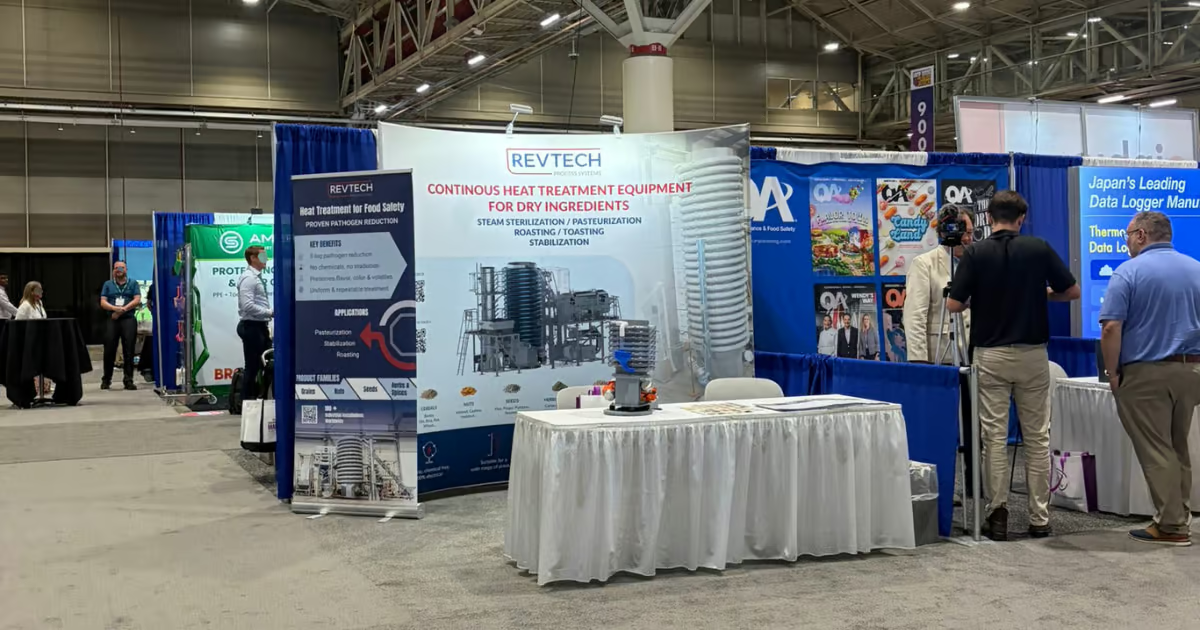

Takeaways from IAFP 2026 (International Association for Food Protection), New Orleans, July 26–29.
A dry product is not a safe product. In a single phrase, that was the thread running through several IAFP sessions this year. Spices, seeds, tree nuts, powders: because water is scarce, we instinctively assume they are safe from pathogens. The reality is the opposite and it has direct consequences for how a microbial reduction step (the kill-step) is designed, validated and documented.

The risk is real, and it persists
The figures presented in New Orleans leave no room for doubt. On the sesame side, an FDA/IFSH session on tahini recalled around twenty Salmonella outbreaks recorded worldwide since 1995, including four in the United States between 2011 and 2019, causing 61 illnesses across 22 states. On the herbs and spices side, Rob Limburn’s review (Campden BRI) covering 2000–2023 counted 25 outbreaks, dominated by Salmonella (roughly 48%) and then Bacillus cereus (roughly 36%); in terms of alerts, black pepper and paprika are clearly at the top.
A recent case shows just how easily these products slip under the radar: in January 2026, a moringa powder (dried leaves sold as a superfood, often taken as capsules) was linked to 97 cases across 32 states, with 26 hospitalizations. Long shelf life, wide distribution, consumption the consumer easily “forgets”: all factors that stretch out the window of exposure. Tahini takes the paradox to its limit, a water activity of 0.16 to 0.25 rules out any microbial growth, yet the product is ready-to-eat, with no lethal step at the consumer’s end, and the infectious dose is low.
Dry does not mean safe.
Water activity: the parameter that decides everything
The central and most counter-intuitive concept is water activity (aw). In thermal processing, the drier a product, the more Salmonella resists heat: thermal resistance increases as aw decreases. In other words, the driest product in a group is the hardest to decontaminate.
The reverse demonstration is just as telling. On sesame seeds, a soaking step drives aw from about 0.10 to 0.98: the Salmonella load then climbs from roughly 2.7 log to more than 7 log CFU/g in 24 hours, a rise of more than 4 log. The FDA underlined the direct consequence: a starting load that high can overwhelm a downstream kill-step, even a validated one. Water, then, is no mere recipe detail, it is the lever that governs both pathogen survival and treatment efficacy.
Validating a kill-step: the worst-case logic
You cannot validate every spice individually. Industry therefore groups products and validates on the one that is hardest to treat. The method presented by Laure Pujol (Novolyze) is rigorous: examine the data distribution (minimum, maximum, average) for aw, moisture, fat, protein and carbohydrate content; then apply hierarchical clustering and principal component analysis to form coherent groups; finally, validate the worst case of each group and confirm it with lab data.
But a message driven home by Shannen Gorman (ASTA) as much as by the FDA, botanical category alone is no longer enough to justify a grouping. You have to measure intrinsic parameters: water activity, bulk density, particle size, plant part, product form (whole or ground — whole pepper and ground pepper do not necessarily belong to the same group). And the critical parameter depends on the process: for thermal, it is water activity (you validate on the lowest aw); for irradiation or gas treatment, it is density. Black pepper, the “king of spices”, was chosen as the representative product for its family not only for its commercial weight, but because its wrinkled surface offers protected cavities where microorganisms survive more easily. Choosing the right worst case is already half the validation.
What the FDA expects and where it breaks down
Elizabeth Grasso-Kelley’s session (FDA) framed the regulatory expectations (21 CFR Part 117). Validation must demonstrate, with scientific evidence, that the control genuinely manages the identified hazard: processing system described, critical factors identified, process variability accounted for, adequate replicates and statistical analysis, worst-case product actually tested. Ian Hildebrandt recalled the level of statistical rigor expected: tolerance bounds giving, for example, 90% confidence that 90% of the product achieves at least the target lethality.
The gaps observed during inspections are instructive: “a typical cycle was run” deemed insufficient, only the average log reduction reported (no min/max), botanical grouping without justification, products of different aw grouped together. Another essential reminder, developed by Grishma Prabhukhot: validation has a shelf life. Reanalysis is required at least every three years, or whenever a change could affect control of the hazard (new equipment, modified process parameters, a new ingredient, a regulatory change, new data on a more resistant pathogen…). A change of supplier, with an identical product, does not necessarily trigger it. Revalidation is not a calendar event: it is a risk-management decision.
The inactivation technology landscape
Jennifer Acuff’s review (University of Arkansas) surveyed the available processes, and heat stands out as a safe bet. On pepper, saturated steam achieves more than 5 log reduction of Salmonella in about one minute at 75 °C. The LSU AgCenter saturated-steam study (presented by Dilashya Shilpakar) confirms the same efficacy on in-shell pecans (more than 5 log in 90 seconds at 80 °C, in 25 seconds at 90 °C) with, as a bonus, improved shelling efficiency. A detail that matters for validation: Enterococcus faecium shows a higher D-value than the pathogens, making it a reliable conservative surrogate; Listeria proved the most heat-sensitive organism.
The other routes each have their limits: radiofrequency is fast but heats unevenly and drives aw down; ethylene oxide is banned in the European Union; chlorine dioxide and ozone remain constrained by regulatory approvals and the push for clean labels; organic acids, like added-moisture treatments, require a drying step afterward. One point raised repeatedly: incomplete hydration leaves “dry pockets” where spores survive, hence the importance of process control, whatever the technology.
In the background: decision tools and AI
Several talks showed the rise of digital decision-support tools. The most striking, presented by Polly Courtney (General Mills), is a scoring tool (a simple Excel workbook) that follows an ingredient along its supply chain and produces a risk score. That score guides the decision: the ingredient can be used as-is in a ready-to-eat product, needs to be secured with additional controls, or should not be used as-is. Its practical value lies above all in comparing scenarios: seeing what would need to improve to reach the target, a bit like a Nutri-Score for microbiological risk. A publication is expected soon.
Artificial intelligence, too, took up growing space: Kerry presented predictive microbial modeling that automates the analysis of growth curves, and the “From Dashboards to Decisions” session (Deepa Thiagarajan) noted that around 70% of players have adopted or plan to adopt AI (for a market estimated at $13.7B by 2030) with success hinging on “one use case at a time, proven before scaling,” the tool staying in service of the human expert. A companion case study by Sean Leighton and Suzy Sawyer, “Change Management Case Study for Digital Adoption,” looked at the human side of that shift: without a named coordinator who owns the relationship between the team and the technology, adoption stalls.
Dry cleaning: the new frontier
The safety of dry products doesn’t stop at treatment: it also plays out in equipment cleaning. In a low-moisture environment, introducing water risks reawakening dormant pathogens, hence the principle summed up at the show as “treat water like glass.” The FDA is pushing in this direction: its guidance Establishing Sanitation Programs for Low-Moisture Ready-to-Eat Human Foods steers toward dry cleaning, or “limited wet cleaning.” The key message: hygiene is designed into the machine from the start, with smooth surfaces and no niches where product accumulates, equipment built to be dry-cleaned. Steam has its place here too, effective on fatty and sugary residues without resorting to chemicals.
At Revtech, this is work we have been pursuing for several years: evolving our designs and testing prototypes to make our equipment easier to clean and better suited to these hygiene requirements.
Our read

What we take away from IAFP 2026 aligns with what we champion at Revtech. First, water activity is the true determinant of a successful thermal decontamination: master it, and you master the outcome. Second, the number-one operational challenge is not reaching a temperature, but ensuring uniformity of treatment because uneven heating, with its cold spots, can lead to overestimating the true lethality. That is precisely where a continuous thermal process sets itself apart from a static-bed treatment.
Our 100% electric approach fits naturally within this framework. It relies on saturated steam (on the order of 1 bar and 100 °C) and offers a concrete operational advantage: where other wet or acid treatments leave the product to be re-dried, our continuous process avoids that step. It also differentiates itself from irradiation and ethylene oxide, two routes presented at the show as constrained or in decline. Finally, the show made one thing clear: validation is a discipline in its own right, and doing it well takes real expertise, that of the laboratories running the studies, of course, but also that of the equipment maker, who understands how the process actually behaves. It is at the meeting of the two that a robust kill-step is built.
Want to go further on continuous thermal decontamination and its validation? Explore our solutions or get in touch.
Sessions & Sources
- IAFP 2026 International Association for Food Protection, New Orleans, July 26–29, 2026.
- Laure Pujol (Novolyze) worst-case selection method: data distribution, hierarchical clustering, PCA, surrogate validation.
- Shannen Gorman (ASTA) science-based grouping of spices, intrinsic characteristics, surrogate selection (E. faecium for steam).
- Grishma Prabhukhot when validation is no longer valid: revalidation triggers; peanut roasting validation study.
- Aaron Uesugi validation strategies that scale across global supply chains.
- Ian Hildebrandt from minor deviation to major redesign: tolerance bounds and statistical rigor.
- Elizabeth Grasso-Kelley (FDA) FSMA regulatory foundations (21 CFR Part 117), validation and revalidation; tahini sessions (Salmonella outbreaks, soaking effect after Zhang et al., 2017; critical control points in tahini processing).
- Rob Limburn (Campden BRI) “Dry but dangerous?”: review of 2000–2023 outbreaks (dried fruits & vegetables; herbs & spices).
- Jennifer Acuff (University of Arkansas) “Battling the Bugs”: overview of inactivation technologies (steam: Ban et al., 2018; Shah et al., 2018; Newkirk et al., 2018; Zhou et al., 2019).
- Dilashya Shilpakar (LSU AgCenter) validation of E. faecium as a surrogate and efficacy of saturated steam on in-shell pecans.
- Polly Courtney (General Mills) “Dry ≠ Safe” decision framework and scoring tool for dry ingredients intended for RTE use.
- Deepa Thiagarajan “From Dashboards to Decisions” (with a Cargill case study); Kerry AI-assisted predictive microbial modeling.
- Sean Leighton & Suzy Sawyer “Change Management Case Study for Digital Adoption.”
- FDA Establishing Sanitation Programs for Low-Moisture Ready-to-Eat Human Foods and Taking Corrective Actions Following a Pathogen Contamination Event: Guidance for Industry https://www.fda.gov/media/184815/download


