Electrolyte removal, also called drying, stripping or evaporation, evaporates the volatile solvents trapped in shredded lithium-ion batteries and recovers them by condensation. Revtech's continuous evaporator is built for this one step, which starts with understanding what's inside a battery.
Continuous evaporator for lithium-ion battery
electrolyte removal & recovery
This solution is part of Revtech’s continuous heat-treatment range for the chemical industry.
What is a lithium-ion battery?
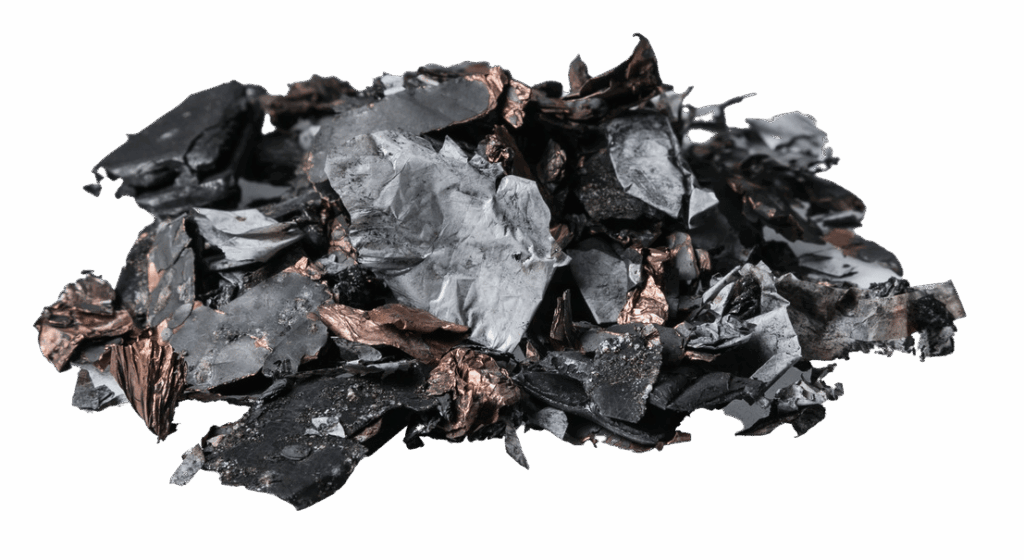
A lithium-ion battery (LIB) isn’t a single material, it’s an assembly of many, packed together inside each cell. When a battery reaches end of life, or arrives as production scrap from a gigafactory, it is shredded, and that assembly turns into a complex mixture that has to be separated so every material can be recovered on its own.
After shredding, a LIB splits into two fractions:
Solid fraction
- Plastics: hard plastics from the casing and thin polymer separator foils
- Copper and aluminum: the current-collector foils
- Ferrous metals: casings and structural parts
- Black mass: the most valuable fraction: a fine dark powder combining graphite (from the anode) with metal oxides rich in cobalt, nickel, manganese and lithium (from the cathode)
Liquid fraction
- The electrolyte: a blend of organic solvents that must be removed before any downstream processing

What is the electrolyte, and what is it for?
The electrolyte is the medium that carries lithium ions back and forth between the anode and the cathode every time the battery charges and discharges, it’s what makes the cell work. In a LIB it’s typically a lithium salt (most often LiPF₆) dissolved in a mix of organic carbonate solvents such as ethylene carbonate (EC), ethyl methyl carbonate (EMC) and dimethyl carbonate (DMC). Those same solvents are volatile, flammable, and, if mishandled during recycling, a real safety and emissions hazard. That’s precisely why removing and recovering them is a critical first step.
Why recycle lithium-ion batteries?
More batteries reach end of life every year — driven by electric vehicles, energy storage, and gigafactory production scrap. Each one is both a hazard to manage and a resource to recover.

- Environmental and safety
Spent batteries don’t belong in landfill or incineration: their electrolytes are volatile and flammable, and mishandled cells pose fire and emissions risks. Recycling neutralizes these hazards at a controlled industrial stage.
- Critical raw materials
The cobalt, nickel, lithium and graphite inside each battery are strategic, largely imported materials. Recovering them creates a local, secondary source — easing mining pressure and strengthening supply-chain resilience.
- Regulation
The EU Batteries Regulation (2023/1542) sets recovery targets of 50% for lithium by 2027 and 80% by 2031, and 90% for cobalt, copper and nickel by 2027, rising to 95% by 2031, plus recycled-content mandates from 2031. Meeting them efficiently is now a direct commercial constraint for recyclers.
Historically, pyrometallurgical processes have been the preferred method for recycling end-of-life (EoL) batteries. The pyrometallurgical process involves treating the EoL batteries at high temperatures to burn off the organic components of the matrix and recover only the high-boiling-point metals. However, the industry is currently seeking processes that are more atom-efficient and less energy-intensive. As a result, alternative processes have emerged, based on a pre-treatment stage, followed by a hydrometallurgical process.
What are the different steps in the recycling process?
The pretreatment stage is the initial phase of LIB recycling, aiming to recover fractions that do not enter the hydrometallurgy process (such as plastics, copper, ferrous and non-ferrous metals, organic electrolyte) and to prepare a black mass for further hydrometallurgical processing. It typically consists of the following steps:
- Shredding: the LIB are shredded to break them down into their constituent parts.
- Electrolyte solvents removal (sometimes called “drying”, “devolatilization”, “stripping” or “evaporation”): The organic electrolyte, composed of flammable and volatile solvents, is evaporated (and recovered by condensation) to ensure safety in subsequent processing steps.
- Material Sorting: Once shredded, the materials are sorted into various streams. A fine powder known as “black mass” is obtained, containing graphite and valuable metal oxides such as cobalt, nickel, manganese, and lithium. Additionally, coarse fraction made of plastic separators, copper foils, aluminum, and ferrous materials are separated for further recovery.
Which systems are available on the market?
Two families of equipment are used today to deal with the electrolyte in shredded batteries.

High-temperature kilns (pyrometallurgical route)
As described above, these treat the material at high temperature and burn off the organic components. They recover the high-boiling-point metals but the electrolyte, graphite and lithium are lost in the process, and the energy demand is high.
Batch vacuum evaporators (or "dryers")
This is the approach that has become the market standard for the dedicated solvent-removal step. Because the shredded matrix contains plastics that soften at moderate temperature, these systems operate under vacuum: lowering the pressure lowers the solvents' boiling points, so the solvents can be evaporated without reaching a temperature that would damage the material. They exist in horizontal and vertical configurations, differing mainly in how the material is held and agitated.
In practice, though, this batch-and-vacuum approach comes with a few structural constraints:
- Batch operation:
Working in successive batches lengthens cycle times and makes it harder to sequence alongside the continuous shredding and sorting steps around it.
- Long cycles, limited throughput:
Heating a deep bed of material through the vessel wall is slow, cycles can run for several hours, which caps the throughput a single unit can deliver.
- Fine powder under vacuum:
Loading and unloading a fine, dusty material containing larger pieces, such as metal parts, plastic fragments, and other debris up to several centimeters in size, while maintaining a tight vacuum seal is operationally demanding and tends to drive frequent maintenance.
These are precisely the constraints a continuous evaporator is designed to remove — which is where the Revtech approach differs.
Why choose Revtech for your LIB pre-treatment projects?
Revtech has partnered with a major player in the recycling industry to co-develop and commercialize one of the few fully continuous pre-treatment processes, covering the entire sequence from shredding to sorting, enabling smooth, reliable, and optimized operations.
How Revtech continuous electrolyte evaporator works
Instead of treating material batch by batch, a Revtech evaporator feeds it continuously into a heated spiral coil, where gentle vibration conveys it forward as a thin, even layer. That thin layer is the key: it gives excellent, uniform heat transfer across the whole flow, and it keeps the treatment consistent and reproducible from start to finish.
Two things are then controlled very tightly:
- the coil temperature is monitored and corrected in real time (within ±1 °C)
- the material moves in plug flow (no dead zones) so every particle sees the same, well-defined residence time (within ±1 minute).
This is also what lets the system remove the electrolyte without vacuum.
Rather than lowering the solvents’ boiling points by pulling a vacuum, Revtech circulates an inert gas through the coil: the gas sweeps away the evaporated solvents and lowers their partial pressure, so even higher-boiling solvents come off at a temperature that stays safe for the plastics in the matrix.
Gas injection and extraction points along the reactor keep this inert atmosphere, and the process under precise control throughout.
The same controlled, inert environment keeps the chemistry in check: holding the right temperature and evacuating the vapors steadily helps limit HF formation, a well-known degradation product associated with LiPF₆, and the extracted gas stream is treated downstream.
And because the solvents are drawn off and condensed rather than burned, the electrolyte is recovered at a quality that can be revalorized, turning a hazard to dispose of into a stream worth recovering.
Key advantages of Revtech evaporator
- Continuous, not batch. The process integrates smoothly between shredding and sorting, with no batch sequencing to manage, and a single system handles throughputs of up to 2 t/h.
- Consistent output. Homogeneous, reproducible treatment means steady black mass quality, batch after batch.
- Electrolyte revalorized, not lost. Solvents are recovered by condensation rather than destroyed, opening a recoverable stream instead of a waste to treat.
- Proven and low-maintenance. The technology has a 25+ year industrial track record, a long operating life, and is designed for reliable, low-maintenance operation.
- Flexible. It adapts to the different battery chemistries and to both production-scrap and end-of-life streams.
- Compact and turnkey. A small footprint, even when several lines are needed for higher throughput and a turnkey approach for fast installation and commissioning.
A continuous alternative to batch vacuum dryers
The same continuous, vibratory technology also powers our continuous calciner, a precise alternative to rotary kilns for chemical powders.
Tell us about your project to arrange a trial on the pilot line.
| Vacuum dryer | Revtech continuous evaporator | |
|---|---|---|
| Operating mode | Usually batch mode | Continuous |
| Cycle / residence time | Several hours per cycle | Residence time < 30 min |
| Throughput per unit | Limited by slow heat transfer through a deep bed | Up to 2 t/h on a single line |
| Line integration | Batch sequencing between continuous steps | Slots continuously between shredding and sorting |
| Solvent removal | Under vacuum, to lower the solvents’ boiling point | Inert-gas stripping — no vacuum required |
| N₂ consumption | Low N₂ consumption | Slightly higher N₂ consumption, due to continuous N₂ flow |
| Process control | Bed- and vessel-dependent | Real-time temperature (±1 °C), uniform residence time (±1 min) |
| CAPEX | Significant CAPEX increase with scale-up, due to parallelisation of production lines | Non-linear CAPEX increase with throughput |
| Footprint | Large footprint — oversized equipment needed to maintain throughput in batch mode | Compact design thanks to reactor geometry; footprint not impacted by throughput |
| Equipment lifetime | Low nitrogen flowrate leads to high HF concentration, which can shorten equipment life | Low HF concentration thanks to dilution in the continuous nitrogen flow — extended equipment lifetime |
| Maintenance | High maintenance requirements, due to vacuum tightness constraints | Low maintenance; 25+ year industrial track record |
All about the LIB pretreatment process
What is the maximum initial solvent content a Revtech evaporator can handle?
The Revtech technology is flexible and designed to adapt to both production scrap and end-of-life streams. Some streams, particularly those originating from production scrap, may contain up to 20 wt% organic solvents and can be effectively processed using the Revtech evaporator.
Can the Revtech process treat a stream of battery shred produced by wet shredding?
Yes. The technology can also remove water from wet-shredded material, as long as the free water content still lets the material be conveyed through the vibratory system. Throughput drops as moisture rises, since more energy goes to evaporating water, so for very wet streams we recommend a mechanical dewatering step (centrifuge, filter press) beforehand.
Up to which material flowrate can Revtech technology be used as a dryer?
A single line handles up to 2 t/h. Higher capacities are reached by running several lines in parallel.
What residual solvent level can be achieved?
It’s tunable. The equipment (typically the coil length) is designed around your target. In its standard configuration, the technology reaches residual solvent contents down to 1 wt% for end-of-life streams and 3 wt% for production scrap.
What residence time can be achieved with a Revtech?
Usually 15–30 minutes in the standard configuration, and it can be extended by lengthening the coil or placing spirals in series. Because the material forms a very thin bed, residence time is much shorter than in conventional systems — so direct comparisons between technologies aren’t always meaningful.
Do you have operating references in the industry?
LIB recycling is still an emerging market, so industrial-scale references aren’t yet available to disclose. The technology can, however, be demonstrated on a dedicated pilot line our partner’s site in France: a fully continuous pre-treatment process (shredding, evaporation, sorting) designed for 1 t/h.
How can I find out whether my process is a good fit, and assess performance?
Testing before committing to a new technology matters. With our partner, we’ve set up a pilot unit where your stream can be run under representative conditions, with full support from both teams and optional add-ons such as online gas analysis. Our process expert can also provide preliminary CAPEX and OPEX estimates for an industrial line based on your case.
Do you provide services beyond equipment supply?
Yes. For the evaporator itself, we provide a turnkey package: design and engineering, assembly, factory acceptance testing (FAT), then disassembly and preparation for shipment. Transport, installation supervision, commissioning, start-up and operator training are available on request. And if you need a full pre-treatment line (shredding, evaporation, sorting) rather than the evaporator alone, our integrator partner manages the complete integration — inter-stage connections, utilities, gas-treatment design and supply.


