
Within the chemical industry, calcination refers to a broad family of thermal processes rather than a single defined operation, varying according to material properties and process goals. Calcination processes involve the thermal treatment of solid materials at elevated temperatures under carefully controlled atmospheres—ranging from air to inert or reactive gases such as hydrogen—to induce precise chemical or physical transformations and obtain tailored end products.
Continuous calciner:
A precise alternative to rotary kilns
What is the purpose of the calcination process?
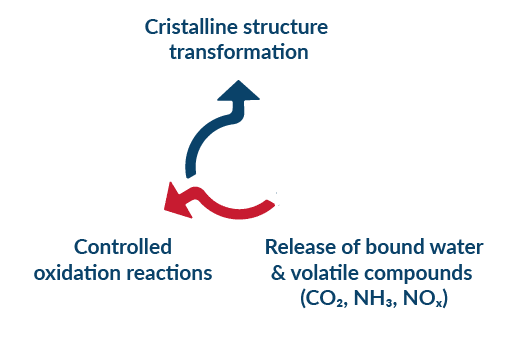
Calcination may induce transformations in the crystalline structure of materials, enables controlled oxidation reactions, or facilitate the release of bound water and volatile compounds such as CO₂, NH₃, or NOₓ. Key industrial applications include the conversion of mineral feedstocks such as clay and limestone into cement with associated CO₂ emissions, alumina production, and the manufacturing of high-value fine chemicals such as catalysts.
Our continuous calciner for your calcination needs
Revtech offers continuous calcination equipment designed for the precise and efficient treatment of solid materials, from powders to shaped materials such as pellets and extrudates. The product is fed into a vibratory tower, where it is heated in direct contact with a hot coil. The gaseous atmosphere can also be precisely controlled, as a defined amount of gas can be injected directly inside the coil (closed system), in direct contact with the product.
Key process parameters—including flow rate, temperature, residence time, and gas injection—are tightly controlled and fully adjustable to meet the specific requirements of each material and application.
Examples of concrete applications of the calcination process developed by Revtech
Revtech’s calcination technology is dedicated to high-value products requiring precise, reproducible, and fully controllable process conditions. It is widely used across the chemicals industry for catalyst activation, sorbent regeneration and the thermal processing of inorganic powders.

Calcination of catalysts and sorbents
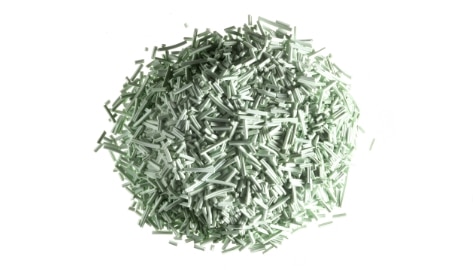
In industry, catalysts and sorbents are essential tools used to precisely control and enhance chemical reactions and material flows, enabling processes to become more efficient, cleaner, and highly selective. They can take various forms, including powders, pellets, and extrudates.
Calcining catalysts and sorbents prior to their industrial use is essential for several reasons. Revtech has developed its expertise in this field over more than 25 years. Revtech’s calcination technology can activate materials by enabling the transition from an inactive to an active state through controlled heat treatment. It also helps remove undesirable compounds such as water, residues, or gases. In addition, Revtech calciners contribute to stabilizing the material structure for improved performance in downstream applications, including higher mechanical resistance and reduced degradation. Finally, calcination can enhance overall material performance, improving catalytic activity, adsorption capacity, and extending service life.
Inorganic powders calcination
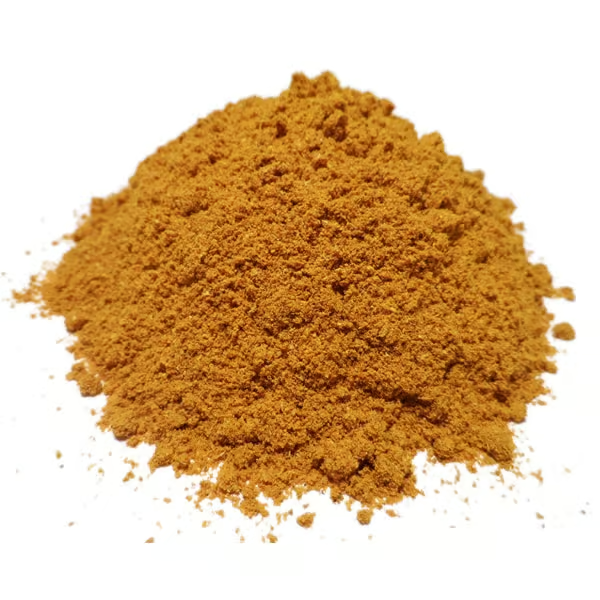
Inorganic powders play a key role in a wide range of industrial applications, including chemicals, minerals, energy, and advanced materials. They are typically used as intermediate or functional materials, requiring precise thermal and process control to achieve the desired properties. Depending on the application, inorganic powders may undergo thermal treatments such as calcination, drying, or activation to modify their physical and chemical characteristics. These processes can influence particle structure, surface area, reactivity, and purity.
Revtech technology enables the controlled thermal processing of inorganic powders, ensuring uniform treatment conditions, reproducibility, and consistent product quality. Key parameters such as temperature, residence time, and atmosphere are precisely controlled to meet specific material requirements. This includes, for example, the processing of metal oxides, even when they are in very fine particle form.
This results in improved material performance, including enhanced stability, reactivity, and suitability for high-value industrial applications.
Continuous calciner vs rotary kiln: a precise alternative
Industrial calciners are often associated with rotary kilns, valued for their robustness and ability to achieve high temperatures and product throughputs. Fluidized beds and multi-plate ovens often complement the range of industrial calcination equipment. However, these conventional systems often provide limited control over critical process parameters, such as residence time, product temperature, and gas atmosphere. They also tend to exhibit long heating times and low energy efficiency.
Why choose Revtech as your calcination equipment manufacturer?
Unlike a conventional rotary kiln, in a Revtech calciner, the material is continuously conveyed through smooth vibrations, allowing it to form a thin, uniform layer inside the coil. This ensures highly homogeneous thermal treatment across the entire product flow. Our continuous calciner allows high heat transfer between the heated coil and the product. The vibratory conveying mode also ensures constant mixing of the material, resulting in a homogeneous, consistent, and highly reproducible treatment.
Several process parameters can be precisely adjusted. The coil temperature is continuously monitored and controlled in real time, allowing rapid correction of any fluctuations (+/- 1°C).
The system operates in plug flow mode with no dead zones, ensuring a highly consistent and well-defined residence time for all particles (+/- 1 minute). Openings on either side of the coil provide multiple gas injections and extraction points throughout the reactor, ensuring precise atmosphere control along the process. This level of precision is difficult to achieve with conventional systems and ensures optimal and consistent treatment across a wide range of products. Beyond its process advantages, the system is also highly robust, with a proven track record in industry for more than 25 years and a long operational lifetime. It is designed for low maintenance, ensuring reliable and cost-efficient operation over time.
The technology is also highly flexible, as each system is tailor-made and fully adapted to the specific needs of each customer, with a customized design for every application.
Finally, it offers complete peace of mind thanks to its turnkey approach, ensuring smooth installation and fast commissioning on site.
Combined, these advantages position Revtech as a leading solution for industrial calcination applications.
All about the calcination process
Up to which temperature and material flowrate can Revtech technology be used as a calciner?
Our technology can reach 700 °C and product throughputs up to approximately 2 t/h, depending on the specific process conditions and the bulk density of the material.
What residence time can be achieved with a Revtech?
Depending on the characteristics of the material, residence times of 40-50 minutes can be reached. The very low bed depth inside the reactor enables a significant reduction in residence time compared to conventional systems, while maintaining excellent process control and product quality. For this reason, it is not always straightforward to directly compare residence times across different technologies, as process conditions and reactor designs can vary significantly.
Do you have operating calciners as references in the industry?
Absolutely! Our equipment has been successfully used in industrial calcination processes for more than 25 years, including the calcination of inorganic powders and catalysts. Upon request, we can provide contacts with existing users and even arrange site visits.
Is a continuous calciner a good alternative to a rotary kiln?
Yes, particularly when process precision matters. Unlike a rotary kiln, a Revtech continuous calciner gives real-time control of temperature, residence time, and gas atmosphere, with shorter heating times and higher energy efficiency. It is especially suited to high-value products that demand reproducible, fully controlled conditions.
Can Revtech calcine catalysts and inorganic powders?
Yes, both are core applications of our technology. We have handled the calcination of catalysts, sorbents, and inorganic powders including very fine metal oxides, and in powder, pellet, or extrudate form, in industrial settings for more than 25 years.
How can I determine whether my process is suitable for Revtech technology, and how can its performance be assessed?
We understand the importance of testing and obtaining reliable results before committing to a new production technology. That is why our headquarters host a pilot unit where your process can be tested under representative conditions. This pilot line is equipped like an industrial scale unit and can handle throughputs ranging from several tens to several hundreds of kg/h, with operating temperatures of up to 700 °C.
Our trial team will provide full support throughout the tests, and we can rent any additional equipment you may require (e.g., inert or reactive gas supply, off-gas treatment) or arrange complementary services (e.g., online gas analysis) to help you evaluate the full potential of our technology.
Our chemical expert can also provide preliminary estimates of CAPEX and OPEX for an industrial line based on your specific case. Do not hesitate to reach out to us for more information.